
Facing the Big One: How a Major Earthquake Could Shake West Salem Retrofit targets vulnerable Center Street Bridge before next quake hits
By Dan Shryock, The West Side Newspaper
The term is synonymous with a worst-case Pacific Northwest scenario: “Cascadia Subduction Zone.”
It’s the Big One, the earthquake that experts say is due anytime, the event predicted to devastate the Oregon Coast and bring the mid-Willamette Valley to a trembling halt.
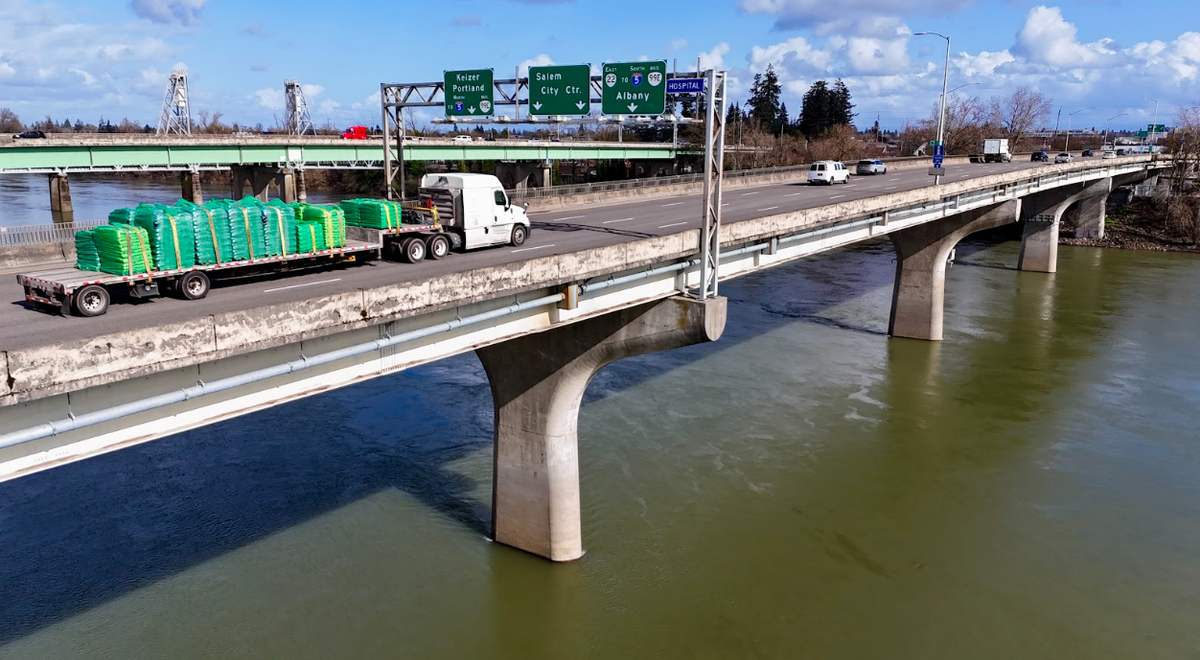
Efforts are being made throughout the state to minimize the effects of a major quake. Work will soon begin to retrofit the Center Street Bridge, with improvements to make sure West Salem’s key conduit to Marion County remains standing after a 9.3 magnitude quake.
And while the bridge’s seismic upgrades will snarl traffic, the alternative is much worse. Without the repairs, there may be no bridge standing once the shaking stops, experts say.
Scientists cannot predict the moment an earthquake will occur, but they can estimate the damage a major temblor can cause.
The effects in West Salem depend on location, says Michael Olsen, a professor of geomatics at Oregon State University and director of the school’s Cascadia Lifelines Program. “You’re going to see a lot of structural damage and landslides up in the hills. Closer to the river, those are areas where you’re going to expect substantial damage.”
Estimating potential damage is difficult, Olsen says, because many variables must be considered. To start, the Cascadia Subduction Zone is an area where two major tectonic plates and as many as 30 fault lines converge. It extends for 700 miles between Northern California and British Columbia. A shift along any of these lines can create seismic activity.
Where a fault ruptures within the zone is important. Activity near California or British Columbia will generate less shaking in Salem. But if an earthquake’s epicenter is off the Central Oregon Coast, Olsen says, the result will be much worse.
The last major subduction zone quake occurred in 1700, and research indicates the next event should take place between the years 2000 and 2200.
Olsen and the Cascadia Lifelines Program staff study the aftereffects of earthquakes around the world and apply those findings to paint a picture of what might happen in the Pacific Northwest. That information helps state and local agencies prepare and mitigate potential damage to infrastructure. That includes West Salem and the Center Street Bridge.
The threat to life and property depends on location, types of structure, and the intensity of the earthquake.
“Wood-frame structures usually perform really well because they’re very flexible and they're able to dissipate a lot of that energy,” Olsen says. “Steel-frame structures and reinforced concrete are also very strong. But I think the challenge is that a lot of our building stock was built before we really knew about earthquake hazards. Older, unreinforced structures are the ones we'd expect to see a lot of collapse.”
Much of West Salem is built on solid basalt rock. While that ground will shake, the damage likely won’t be as severe as areas near the Willamette River.
“Areas closer to the river can expect a lot more damage,” Olsen says. “That’s where you’re going to have potential liquefaction because it’s going to be more saturated soils.”
Olsen explains: “Liquefication is basically where you have a lot of strong shaking and loose sands. As you get that shaking, it's causing water pressures to rise, and that causes the sand grains to separate, meaning they no longer hold up the building. The water does. When the shaking stops, things settle, and buildings tilt.”
A seismic retrofit of the Center Street Bridge is crucial because that structure’s supports are primarily positioned on land vulnerable to liquefaction.
The bridge project’s first phase targets the piers that hold up the bridge’s road surface and ramps on the Marion County side of the Willamette River. Reinforcing the footings will guard against movement when the riverbed shifts and shakes. The retrofit may begin late this year, according to the Oregon Department of Transportation (ODOT).
A second phase, still under study, will stabilize the Highway 22 ramps that lead from West Salem up to the bridge. Many of the current vertical supports are positioned on land threatened by liquefaction. This work is not yet scheduled, ODOT spokesperson Mindy McCartt says.
Should the Center Street Bridge be damaged, West Salem would be cut off from services on the east side. The nearest bridge that currently meets Cascadia Subduction Zone-level earthquake standards is in Corvallis.
The most recent Center Street Bridge upgrade was completed in the 1980s. The companion Marion Street Bridge was built in the 1950s and is not scheduled for repairs.
Most of the bridge work during Phase 1 will be done under the bridge and while traffic will generally be normal on the bridge itself, drivers should expect lane restrictions and ramp closures.
The three-year Phase 1 project will cost more than $180 million. Costs for Phase 2, another three-year effort, are not yet known.