


Community volunteer Laura Crofoot Oversees Helping Hands Resources Expansion
- Casey Chaffin
- Feb 5
- 4 min read
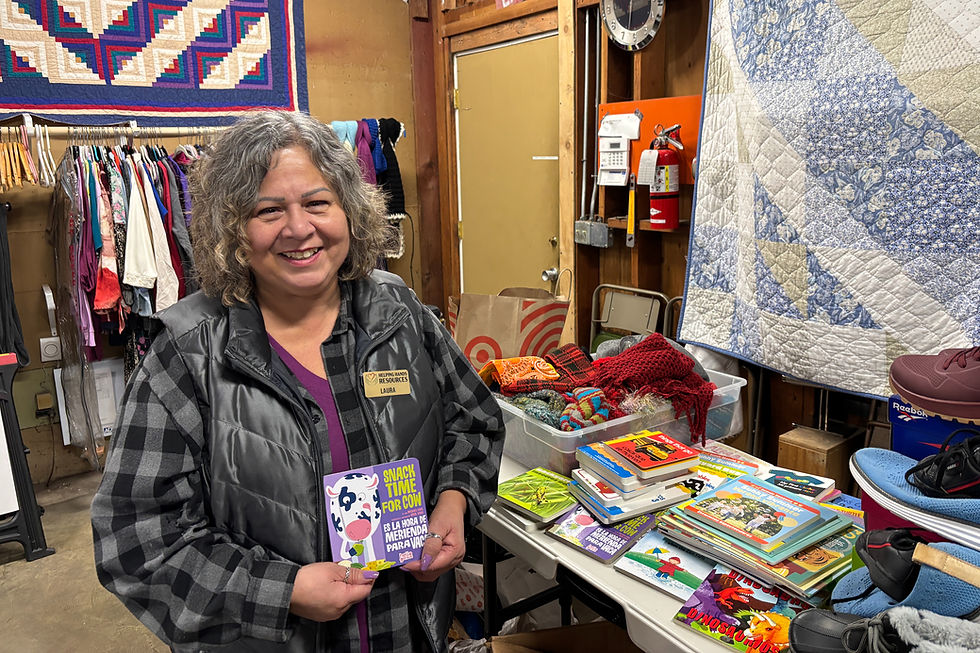
Among the racks of donated clothes at Helping Hands Resources, Laura Crofoot has tears in her eyes.
She’s talking about how the organization, dedicated to providing clothing, housewares, and other supplies to unhoused people, low-income families, and anyone else in need, tries to never turn people away empty handed.
She’s seen volunteers take the jacket off their back to make sure a client can stay warm.
“Every day, someone says, ‘I love you,’” Crofoot said.
Helping Hands Resources is set up like a thrift shop, where people can come once a week and fill a bag with clothes and other items at no charge. They also work with other nonprofit agencies to provide what they call ReStart kits, a package of housewares, cleaning supplies, and other items to get someone set up when they enter housing after experiencing homelessness.
Crofoot is no stranger to this work. She’s volunteered at Helping Hands Resources for 10 years, and has served as board president for five. In 2024, she was recognized by the City of Salem as the Lisa Letney volunteer of the year for her work with unsheltered people.
Her passion for the livelihoods of her community members comes through in how she’s led the organization in her time as board president. Helping Hands’ client base and capacity have increased significantly in the 10 years she’s served as a volunteer.
In 2023, Helping Hands logged more than 8,000 check-ins to shop for clothes. In 2025, they counted 22,000 — and each check-in often includes multiple family members. Their ReStart program began in 2017, when they distributed 12 kits to people exiting homelessness. In 2025, they distributed 271.
Last year, Helping Hands applied for and received a nearly $1 million grant from the State of Oregon that has allowed them to purchase, renovate, and expand the warehouse where they store donations. The warehouse will become an extension of the current shop, allowing the organization more room to serve clients.
The organization stays afloat through the dedication of more than 100 volunteers, partnerships with other nonprofits, monetary and in-kind donations, and grants.
Helping Hands Resources works within a network of service providers and community organizations who share supplies and support with each other. When Helping Hands has too many clothes to store, they donate to other nonprofits. Habitat for Humanity donates diapers to Helping Hands’ shop. Churches and local businesses have donated much-needed necessities.
“We share our abundance,” she said. “We’re all doing the same work.”
The organization has no paid staff. Eight people serve on the board, and the rest of the work is done by community volunteers.
“Some volunteers are here seven days a week,” Crofoot said. Many of them bring home clothes to sort, mend, and catalog.
Crofoot said many of the people who volunteer with Helping Hands have their own personal experiences with homelessness. Volunteers have confided in her that they’ve had family members experience homelessness, and not all of them have made it out.
Crofoot’s dedication to meeting the needs of unhoused and low-income people also began with personal experience. After her family moved to West Salem in the 1980s, two of her siblings became homeless.
Her family struggled to understand what kept her siblings outside. They didn’t understand the complex underlying mental health issues that drove them into and kept them in homelessness, she said.
In the 1990s, she started preparing hot meals to serve at Wallace Marine Park. She collected donations from family members and friends to pay for food and survival supplies for the people who lived in the park. She found that when she began running low on food, people would check in on each other to make sure everyone had eaten something.
“I realized they were their own community,” she said.
Crofoot is proud of the work she and the organization have done, but she knows there’s still a lot of unmet need. She sees people move into housing, and also witnesses people who die on the street. Her sister died of an overdose at age 30. It took her family 20 years to get her brother into mental health treatment and housing.
Her family’s story has prepared her to talk about homelessness in her own neighborhood of West Salem. Conversations about homelessness can be difficult, especially when there’s a clear divide between people who live on the hill and those who live in Wallace Marine Park, she said.
“There’s so much privilege and it makes people uncomfortable,” Crofoot said. “The big thing is not to villainize or demonize anyone. You never know someone’s story.”
Crofoot has also seen support from West Salem community members for her outreach work. When she posts on Facebook she’s headed over to Wallace Marine Park to distribute supplies, a pallet of Gatorade will appear on her front step. She’s received anonymous donations from neighbors for years.
Crofoot often hears from people who she and Helping Hands have supported. She recently received a Facebook message from someone who used to live in Wallace Marine Park and has since moved into transitional housing. They wrote to Crofoot: “Your friendship helped me through a lot of my time on the streets, and I just wanted to say thank you.”
This is the reason why Crofoot and the volunteers at Helping Hands spend so many hours doing the work that they do.
“We’re back up for a lot of people who don’t have family,” Crofoot said. “I try to be that mom, that sister.”
More information about Helping Hands Resources, including how to access their services, sign up to volunteer, and make a donation, can be found on their website: helpinghandssalem.org.



Comments