


Steve Anderson: A Household Name in West Salem
- Staff
- Feb 5
- 4 min read
Updated: Feb 5

Steve Anderson lives his life by the philosophy that one should be a good steward of the environment.
A Salem, Ore., native and Land Use Chair of the West Salem Neighborhood Association (WSNA) for the past 13 years, you could say that Steve Anderson is a household name. You could also say that you don’t have to look very hard to see that Anderson’s life has been shaped around identifying problems and solutions concerning the environment, and giving a voice to those who don’t have one.
He spent his childhood outside, playing in the tide pools and observing the species that lived in them. During the summers, he’d spend time with his grandpa, a logger who lived in southern Oregon and taught Anderson the eco-friendly practice of selective tree cutting to help with overall forest health. These summers would end up playing a formative role in his future career.
“I owe all that to my grandfather,” he says. “That’s where I learned a lot of my environmental experience from.”
Taking that passion into college, he studied oceanography and Fishery Science at Oregon State University (OSU). From there, he went on to get a master’s degree in Zoology and Environmental Science at Brigham Young University before completing a PhD in Environmental Engineering – a track that could easily have placed him inside a classroom, teaching.
That was when Anderson and his professor came to a similar conclusion: Anderson liked to get out and get his hands dirty. He liked to solve problems, and in many ways, teaching is the opposite of that.
“My professor said that I would probably not fit into a university environment,” Anderson said with a chuckle. “So he had me take a Masters in Business Administration, Minor,” a field that could help to broaden his scope of employment when he graduated with his doctorate.
The combination of these impressive degrees saw Anderson in the field, dealing with toxic chemicals and learning how to clean up the environment. On the business side, he engaged in risk analysis and problem solving, and effectively changed the direction of businesses and organizations.
After a move to California so his wife could begin working for U.S. West (one of the seven baby Bell’s after the anti-trust split of AT&T) as one of the first female executives in the communications business, Anderson began a successful environmental consulting business that took him to work for agencies like the U.S. Coast Guard, Massachusetts Institute of Technology (MIT), and the California Energy Commission. Following a stint in Philadelphia working with underprivileged, inter-city youth, Anderson and his wife moved back to Oregon, first to Corvallis, then to West Salem, where they bought property to raise their two sons on.
This was when he got involved with WSNA.
“I started going to the neighborhood association meetings to kind of get reconnected with the neighborhood,” Anderson said. “And then, in 2011 or 2012, they were going through their annual elections and nobody was volunteering for the vacant position of Chair. And I just felt prompted to step up and do something in the community.”
His background in the environmental field eventually led him to being sworn in as the Land Use Chair, and that’s where he’s been for the last 13 years, including nine years as co-chair of Edgewater Partners, working hard to ensure that people in the community are heard.
“I’ve always been interested in making sure that those people that don’t have a voice have a voice,” Anderson said.
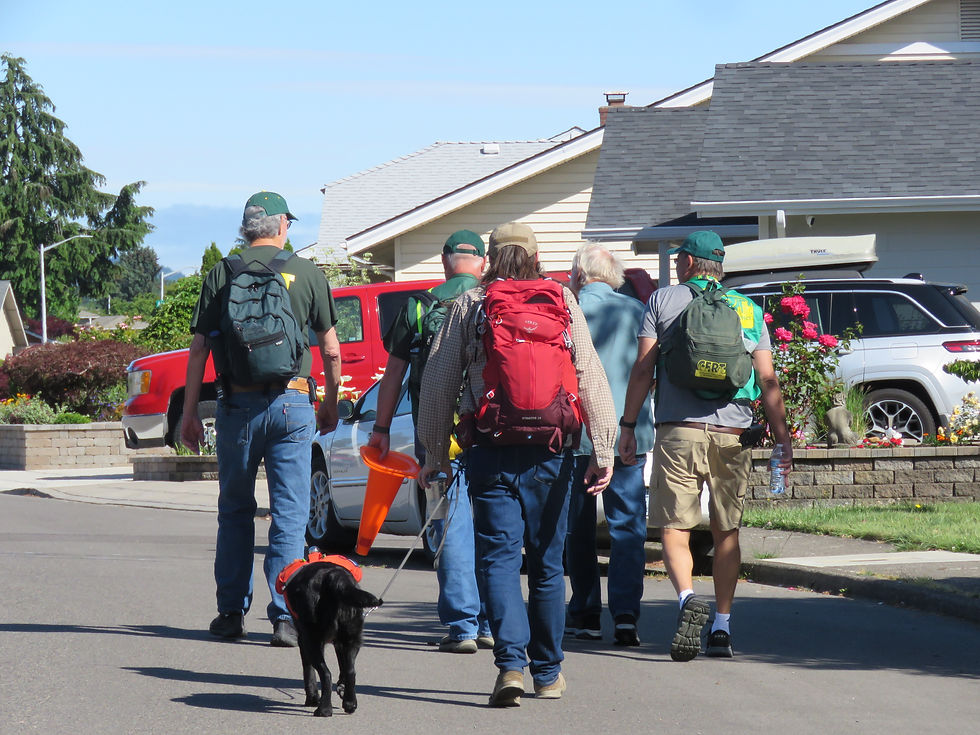
Neighborhood Associations exist to act as a kind of liaison between local and state governments. They help to bridge information gaps and engage with the community in ways that certain members of the public might not otherwise have access to. Some projects that WSNA has been involved in is supporting the Edgewater Neighborhood Partnership Team; helping to establish the Thursday farmer’s market that occurs during the summer; the Concerts in the Park series; the Peace Walk, a local event where residents walk together to promote neighborhood unity; a bike rodeo, where the police come out and teach kids about bike safety; and more. Each project the association takes on aims to reach the community in a positive way.
WSNA also ensures that when development comes in, it falls under the umbrella of state land use goals and rules. Since Goal One is required to allow the public to participate in each part of the process, developers will send the association a proposal so that they can look at it and make comments and ask questions.
“It’s a way to pull the community together and have a forum to talk about community needs and actions.” Sometimes, this will mean going to the City Council to make recommendations.
“Some cases can get contentious,” Anderson said, “but for the most part everyone gets along and we have fun together.”
On top of everything else he does, Anderson still does part-time consulting work for clients like the Oregon Legislature.
“The kids keep saying I need to retire,” he laughs. “But it’s hard not to want to stay engaged at least part-time. I can’t give up on it. That’s just who I am.”
When he’s not knee-deep in local environmental issues, Anderson likes to go whitewater kayaking and ride his bike through Minto Brown Island Park. He says he’ll do anything that gets him close to nature.
Steve Anderson contact info:
Phone: 503-602-1623


Comments